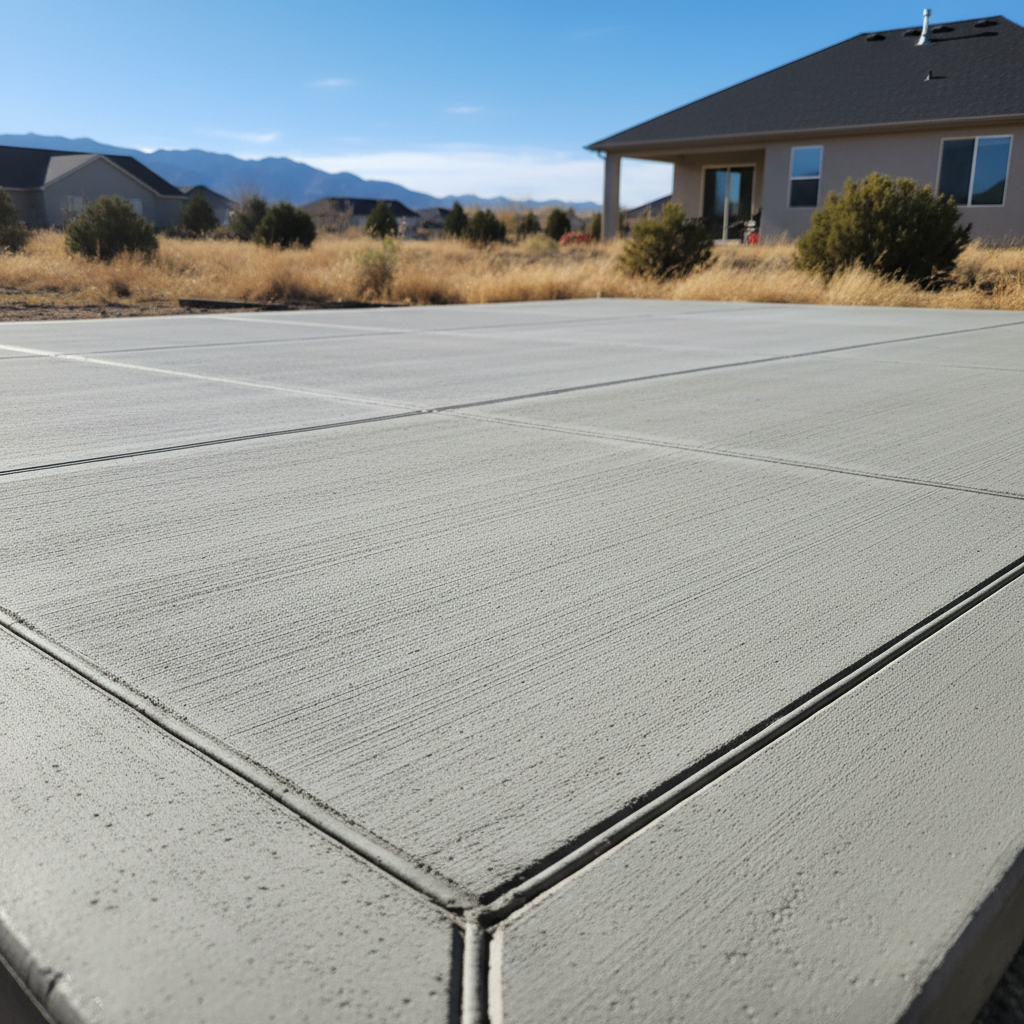
Planning a backyard upgrade usually starts with a bunch of questions. If you are looking at pouring a new Concrete Patio right here in Kearns, you want straight answers that do not dodge the realities of our local climate. Between the heavy clay soil and the winter freeze-thaw cycles we get along the Wasatch Front, doing the job right matters. Here is the unvarnished truth based on what we see every day running Kearns Concrete.
How thick should a backyard Concrete Patio actually be?
For a standard residential Concrete Patio, four inches is the industry baseline, and it is what Kearns Concrete typically pours. If you are planning on putting a massive stone hot tub on it, parking a heavy utility trailer, or rolling a heavy camper across it, we need to bump that thickness up to five or six inches and add proper reinforcement. Skimping on thickness to save a few bucks on concrete truckloads always comes back to haunt you when the slab cracks under pressure.
Will my new Concrete Patio crack, and can you prevent it entirely?
Every concrete slab will crack eventually, because it is just the nature of the material. Honest contractors will not promise you a completely crack-free surface. What Kearns Concrete can do is control where those cracks happen by cutting clean control joints and ensuring the sub-base is compacted tightly. Kearns soil can shift as it gets wet and dries out, so proper grading and gravel prep are your best defense against ugly, random cracking.
How long do I have to wait before I can walk or put furniture on a Concrete Patio?
You can usually walk carefully on a new Concrete Patio after 24 to 48 hours. However, curing is a chemical process, not just drying. Concrete takes about 28 days to reach its full structural strength. Kearns Concrete always tells homeowners to wait at least a week before dragging heavy patio furniture, grills, or fire pits across the surface to avoid gouging or chipping the fresh edges.
Do I need a permit from Salt Lake County for a backyard Concrete Patio?
Most simple, ground-level flatwork patios that do not cross property lines or alter major drainage patterns do not require a strict building permit in unincorporated Salt Lake County or Kearns metro township areas. But if you are pouring close to your property line, tying into existing structures, or building multi-tiered setups, it is always smart to double-check local codes before the first scoop of dirt gets dug out.
What kind of maintenance does a plain Concrete Patio need?
Concrete is not completely maintenance-free, but it is straightforward compared to wood decking. Sweeping off debris and washing it down with a hose keeps dirt from staining it. Kearns Concrete also strongly recommends applying a breathable masonry sealer every couple of years. Sealer stops moisture from sinking into the pores, which protects your Concrete Patio when winter temperatures drop below freezing.
Can you pour a new Concrete Patio right over my old, busted concrete slab?
Sometimes homeowners want to slap a new layer on top to save demolition costs. In almost every case we see around Kearns, that is a bad idea. If the old sub-base failed and the old concrete is sinking or cracking, a new layer on top will just mirror those exact same cracks within a year. It is almost always better to tear out the old mess, fix the sub-grade, and start fresh with a solid foundation for your Concrete Patio in Kearns, UT.